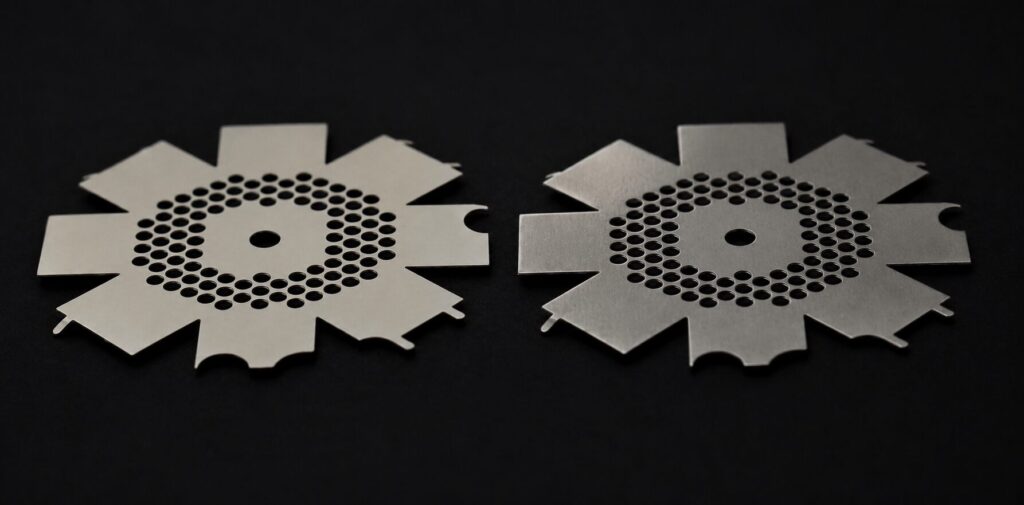
Selecting the right material is one of the most important decisions engineers make when designing parts for the etching process. It requires balancing performance requirements, manufacturability, and program risk, especially when working with thin-gauge metals and intricate geometries. Factors such as etch rate, mechanical strength, corrosion resistance, conductivity, and cost all influence how a material will perform during production and in service.
Early material selection directly impacts yield, tolerance stability, and long-term reliability. Choosing the wrong material can lead to inconsistent features, edge distortion, or unnecessary post-processing, while the right choice enables clean, repeatable results from the start.
At Microphoto, we specialize in precision photochemical machining for thin, intricate metal components where flatness, dimensional accuracy, and burr-free edges are critical. As material specialists, we work with a wide range of metals to ensure accuracy, precision, and performance.
In this article, we provide practical guidance on selecting the best materials for chemical etching, with a focus on beryllium copper, phosphor bronze, and other commonly used metals.
Understanding the key characteristics of different metals is essential when designing for photochemical machining. Each material behaves differently during processing, influencing both manufacturability and final part performance.
Strength, ductility, and hardness determine how a material performs in an application. A strong copper alloy may be ideal for spring elements, while softer materials allow easier forming after etching.
Etch rate and uniformity affect dimensional accuracy. Materials that etch evenly produce more predictable results, especially in fine features and tight tolerances. The chemistry used, often including ferric chloride and hydrochloric acid, plays a key role in controlling these outcomes.
Photochemical machining produces parts that are inherently burr-free, preserving the original grain structure without introducing stress or deformation. Maintaining a consistent metal surface is critical for components requiring tight tolerances and clean edges.
For functional parts, properties like corrosion resistance, electrical conductivity, and thermal conductivity are essential. These attributes influence performance in environments ranging from electronics to industrial applications.
Beryllium copper is widely regarded as a premium material for precision photochemical machining. Known for its exceptional strength, elasticity, and fatigue resistance, it is often referred to as a high-performance spring copper.
From an etching perspective, beryllium copper offers excellent uniformity, allowing for fine features and complex patterns to be produced with confidence. This makes it ideal for high-reliability applications such as spring contacts, connectors, and lead frames used in advanced electronics.
Its combination of mechanical strength and consistent etch behavior enables engineers to achieve high precision results, even in thin sections. However, the material does come with higher costs and requires careful handling due to health and safety considerations during processing.
When performance is critical, particularly in applications requiring durability and flexibility, beryllium copper often provides a clear advantage over alternative materials.
Photo-etched beryllium copper parts are often used for electrical connectors, metal enclosures for electrical circuits, circuit boards, EMI/RFI shielding, and other components requiring broadband shielding effectiveness. Additional components made of beryllium copper include:
At Microphoto, we specialize in high precision and tolerance beryllium copper parts used in various electrical applications.
Phosphorus bronze, commonly referred to as Phos-bronze and sometimes Tin bronze, is another widely used material in photochemical machining, valued for its balance of strength, wear resistance, and corrosion performance. As a durable copper alloy, it is commonly selected for electrical contacts, springs, and precision components.
One of the key advantages of phosphorous bronze is its ability to produce smooth, clean edges during etching. This makes it perfect for parts requiring tight tolerances and consistent geometry, especially where edge integrity is critical.
Compared to beryllium copper, phosphor bronze typically offers slightly lower strength but improved cost efficiency and easier handling. Its predictable etch rates and stable dimensional behavior make it a reliable choice for a wide range of applications, including electronic components, precision connectors, and circuit boards where high electrical performance is required.
Phosphor bronze is also highly resistant to wear and corrosion, making it well-suited for demanding environments. For many designs, it represents an ideal balance between performance, manufacturability, and cost.
Phosphorous bronze is most generally used for electrical contacts and certain dental bridges. These applications benefit from reliable etched pieces that combine durability with fine detail.
While beryllium copper and phosphor bronze are widely used, several other materials are commonly selected depending on application requirements.
Stainless steel offers excellent corrosion resistance and dimensional stability, making it suitable for harsh environments and metal enclosures. However, it typically has slower etch rates, which can impact production efficiency.
Photo-etched stainless steel parts can contain various elements depending on the application at hand, including nickel, carbon, chromium, and more. Microphoto produces photochemical etched stainless steel parts without compromising the mechanical or elemental integrity of the material.
Nickel provides high strength and chemical resistance, making it ideal for wear applications. Nickel silver combines durability with aesthetic appeal, often used in decorative and functional components.
With high thermal and electrical conductivity, Nickel-Silver is an ideal electronics-grade alloy. While its name would indicate otherwise, Nickel Silver does not actually contain silver. Instead, the material is composed of Copper, Nickel and Zinc.
Applications such as audio components, jewelry, food/sanitary and marine fittings, lead wiring, battery, and electronic connectors, and more use nickel-silver to maintain the integrity of their products.
Aluminum is lightweight and offers strong electrical and thermal conductivity. While highly versatile, it requires specialized chemistry during acid etching to maintain accuracy and avoid surface inconsistencies.
Since 1965, we have photochemically etched high-quality precision Aluminum parts for critical applications. At Microphoto, customer satisfaction is our utmost priority. Compliant with ISO 9001, our robust quality management system ensures that every etched-metal part meets applicable industry standards and project specifications.
Each material presents trade-offs in machinability, etch uniformity, and post-processing requirements. Compared to laser cutting or other traditional machining processes, photochemical machining eliminates heat-affected zones and mechanical stress, making it particularly advantageous for thin, delicate parts.
View all the materials Microphoto etch.
Material selection directly influences what is possible in photochemical machining. Certain metals allow for finer features, sharper corners, and more intricate geometries than others.
For example, materials with uniform etch characteristics enable the production of small apertures, thin webs, and complex designs without compromising edge quality. This is especially important for applications requiring precise alignment or electrical performance.
Because the process does not introduce mechanical stress, parts retain their original properties, resulting in improved fatigue resistance and long-term reliability. This is a key advantage over conventional metal fabrication processes, in which forming or cutting can alter material properties.
In many cases, selecting beryllium copper or phosphor bronze can provide a measurable performance advantage, particularly in applications requiring flexibility, durability, and consistent edge integrity.
Material selection also plays a significant role in overall project cost and scalability. While premium materials may have higher upfront costs, their superior etch performance can reduce waste and improve yield.
Photochemical machining offers low-cost tooling, making it ideal for both prototyping and production. Unlike stamping or hard-tooling methods, design changes can be implemented quickly and at minimal expense.
Material availability and processing efficiency also affect lead times. Metals that etch more predictably can move through production faster, supporting both small and medium production volumes.
By carefully balancing material cost with etch efficiency and performance requirements, engineers can optimize both budget and timelines.
Choosing the right material requires a clear understanding of both application needs and manufacturing constraints.
It’s important that you:
Early collaboration with experts in metal etching ensures that materials are selected with both design intent and manufacturability in mind.
Material selection is more than a technical decision; it is a powerful design lever that can enhance the performance and reliability of your components.
The right choice amplifies the advantages of photochemical machining, enabling photo-etched parts with exceptional accuracy, clean edges, and long-term durability.
By aligning material properties with design requirements and production goals, engineers can achieve better outcomes across the entire product lifecycle.
At Microphoto, we work closely with customers to evaluate materials against real-world performance needs and customer specifications, ensuring every part meets the highest standards.
If you are developing a new component or refining an existing design, our team is here to help you select the optimal material and achieve the best possible results.