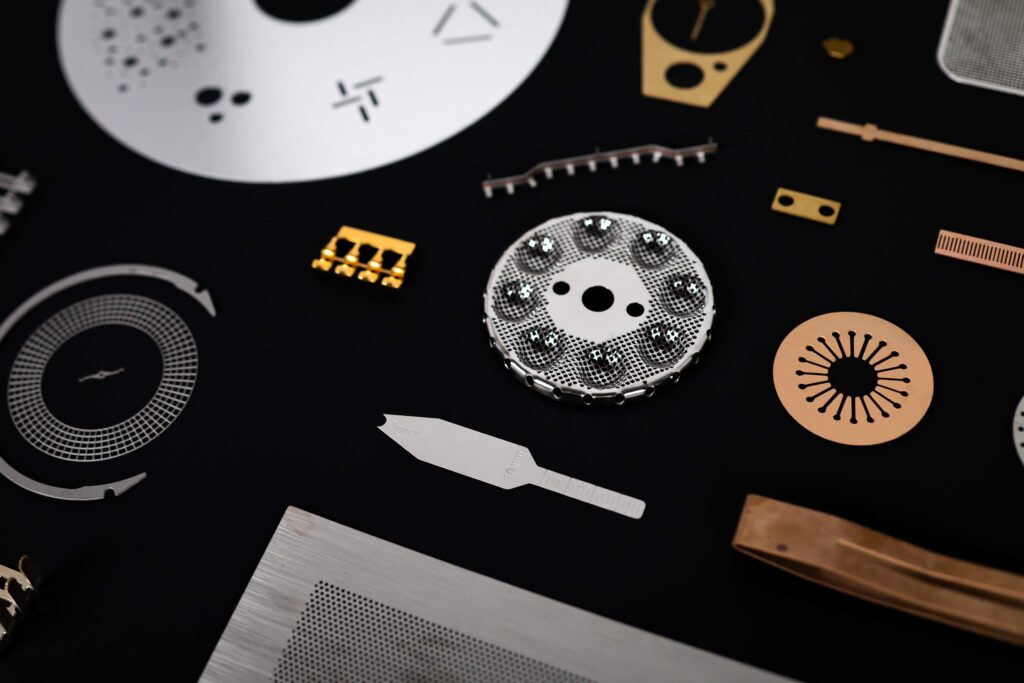
When engineers begin developing thin, intricate metal components, one of the earliest and most consequential decisions is selecting the right manufacturing process. Beyond just cost, the choice affects everything from tolerances and edge condition to material behavior, scalability, and long-term program risk.
Too often, metal stamping is treated as the default. But for complex geometries in thin-gauge materials, assuming stamping is the best fit can limit design flexibility before production even begins.
Photochemical machining offers a fundamentally different approach. Instead of shaping or cutting metal with force, it removes material through a controlled chemical reaction. That difference in mechanism has downstream implications for material integrity, edge quality, tooling cost, and revision flexibility.
In this article, we compare the photochemical machining and metal stamping processes for manufacturing intricate thin metal parts. We break down where each process excels and why, and explain why photochemical machining often delivers a level of design freedom and stability that mechanical stamping cannot match.
Before comparing cost, tolerances, or scalability, it’s important to understand the fundamental difference between these two processes.
Metal stamping uses mechanical force to cut or form metal. Punches and dies define geometry, and the material is sheared or formed under pressure. In micro stamping applications, tooling is designed to create small metal stampings with precise features at scale.
This cold-forming manufacturing process is highly efficient for repeatable geometries at high volume. However, the interaction between punch, die, and material thickness introduces mechanical stresses. Tool design, clearance, and alignment directly influence edge quality, dimensional consistency, and long-term stability.
Microphoto is committed to taking your metal part from print to finished product quickly and affordably with our custom metal stamping services. With in-house machining and design capabilities, our highly skilled tool-makers can construct stamping dies with complex parts, shapes, and features. This ensures our stamping lines consistently produce conforming parts, even when challenging designs are involved.
Photochemical etching, aka machining, uses a very different mechanism. A photoresist is applied to both sides of the metal sheet and selectively exposed to define geometry. The exposed metal is then removed using a controlled chemical etchant in a highly regulated photochemical machining process.
No mechanical force or heat is introduced during the process. Geometry is chemically defined rather than mechanically sheared. That fundamental difference drives nearly every downstream advantage of photochemical machining, particularly for intricate components in thin-gauge materials.
Microphoto is a leading expert in photochemical machining, consistently delivering complex metal parts with tight tolerances and intricate designs. Our proven photochemical etching process delivers unmatched precision and repeatability for industries that require intricate metal components.
Complex geometry is often the deciding factor in process selection.
In stamping, geometry is constrained by the physical realities of punch and die tooling. Clearance requirements limit how closely features can be spaced. Extremely fine slots, small apertures, thin webs, and complex internal patterns can challenge tooling strength and longevity. Achieving these features may require multiple operations or secondary processing.
Photochemical etching, by contrast, defines geometry through artwork rather than physical punches. Fine slots, mesh patterns, complex internal cutouts, and intricate profiles can be produced in a single operation. Because material is removed chemically rather than sheared, internal complexity does not require additional mechanical steps.
For engineers designing precision metal components such as encoder disks, sensor grids, battery contacts, or shielding elements, this design freedom can significantly reduce part consolidation and simplify assemblies.
The advantage is not simply about feature size. It is about enabling geometry that would otherwise require complex progressive dies or secondary machining operations, increasing both cost and program risk.
Mechanical shearing inevitably affects material structure. During stamping, the punch deforms the metal before fracture occurs. This can introduce work hardening, stress zones, and edge rollover. Burr formation is common and often requires secondary deburring to meet quality standards.
Over time, tool wear further impacts edge condition and dimensional consistency. As punches dull, burr height can increase, and edges may become less predictable, especially when tight tolerances are required.
Photochemical machining avoids these mechanical effects. Because material is dissolved rather than fractured, edges are burr-free and free of mechanical stress. There is no work hardening and no microcracking. Base material properties remain unchanged.
For applications in medical devices, aerospace assemblies, and electronic shielding where flatness, edge definition, and material performance are critical, preserving integrity is essential. Thin stainless steel components, in particular, benefit from a process such as photochemical machining, as it maintains flatness and dimensional stability without introducing mechanical distortion.
When it comes to tooling, both processes vary significantly.
Metal stamping requires hardened steel dies and punches. For complex parts, these tools can represent a substantial upfront investment. Lead times for tool design, fabrication, and qualification may extend program schedules. Once built, modifying tooling to accommodate design changes can be costly and time-consuming.
Photochemical machining, on the other hand, relies on photo tools derived from digital artwork. These are comparatively inexpensive and quick to update. If geometry changes during prototyping or early production, revisions can be implemented without rebuilding hardened dies.
When evaluating cost, it is important to look beyond unit price. Tooling amortization, revision frequency, and program uncertainty all influence the true economic picture. For evolving designs or lower-to-medium volumes, photochemical machining often provides a more cost-effective solution by reducing capital risk and shortening development cycles.
Production volume is often a deciding factor in manufacturing process selection, as scalability and cost efficiency can shift significantly depending on demand stability and order size.
Stamping excels at high-volume production. Once tooling is amortized, per-part cost can be extremely low. For stable designs with simple geometry and predictable demand, stamping is highly efficient and reliable.
Photochemical machining remains competitive at low-to-medium volumes and scales effectively as demand increases. While per-part cost may not match stamping at very high volumes, it eliminates the need for significant upfront tooling investment.
For programs with uncertain forecasts or fluctuating order quantities, the flexibility of photochemical machining can reduce financial exposure while maintaining production capability.
Dimensional control over time is another key differentiator of the two processes.
In stamping, tolerances are closely tied to tooling conditions. As tools wear, feature definition can drift. Regular maintenance and requalification are necessary to maintain tight tolerances across long production runs.
In photochemical machining, geometry is chemically defined by artwork and controlled process parameters. Because there is no physical punch to wear, dimensional consistency remains stable over extended runs, especially in thin materials.
For precision parts requiring tight tolerances in thin-gauge metal, this predictability enhances reliability. Consistent edge definition and flatness are maintained without mechanical deformation influencing outcomes.
Both metal stamping machining services and photochemical machining have legitimate roles in precision manufacturing.
Metal stamping is a smart choice when:
Photochemical machining is preferred when:
In many industries, the best approach is not to assume one method universally applies, but to evaluate the specific part requirements early.
Selecting the right manufacturing process is about aligning geometry, material thickness, performance requirements, and production volume. For engineers developing intricate components, engaging in early-stage process evaluation can reduce risk and unlock design freedom.
Stamping is a smart choice when parts feature relatively simple geometries, production volumes are extremely high, and designs are unlikely to change over time. In these scenarios, the upfront tooling investment can be justified by low per-part costs and highly efficient, repeatable production once manufacturing is fully scaled.
For thin, intricate components where flatness, edge definition, and design agility matter, photochemical machining frequently outperforms mechanical alternatives. The absence of force and heat preserves material integrity. The flexibility of phototooling supports rapid design changes, while the predictable geometry supports consistent performance over time.
Microphoto is a trusted expert in both precision manufacturing methods, specializing in custom, precision metal parts, which are burr-free, stress-free, and exact to requirements.
As leaders in precision photochemical machining, we’ve built a reputation for delivering complex, thin metal parts across regulated and high-performance industries. With deep expertise in evaluating part geometry and program requirements, we help engineers select the process that supports both technical performance and long-term program success.
If you are weighing up the right process for your next precision manufacturing project, talk to the Microphoto team for expert guidance or request a quote.