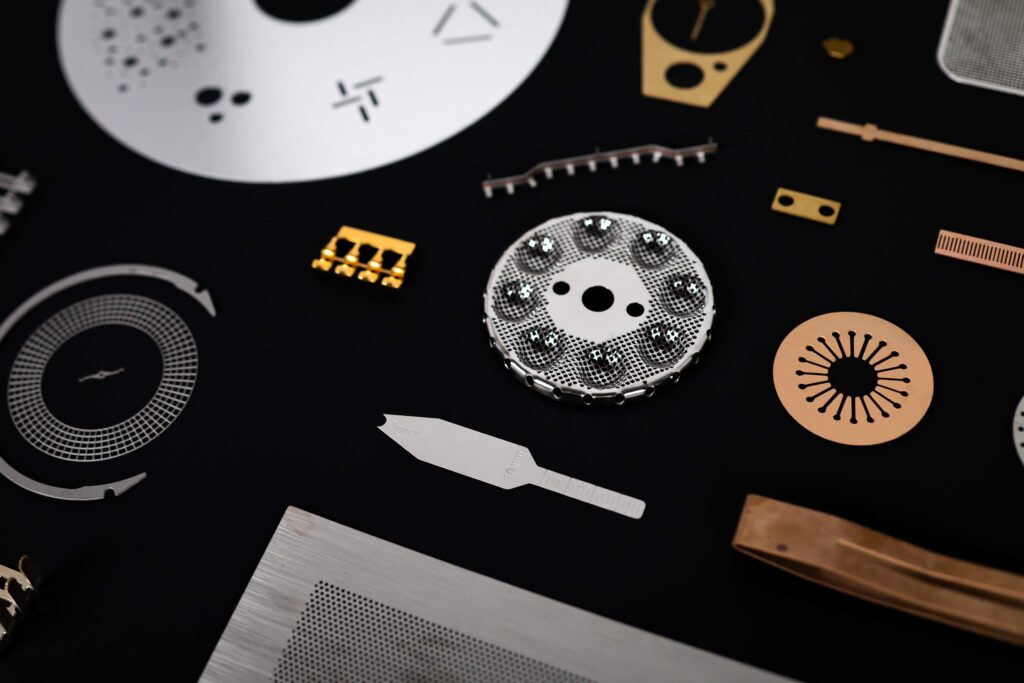
For many precision metal components, manufacturing does not end once the part is etched, formed, or fabricated. Surface finishing plays a critical role in determining long-term performance, durability, and reliability.
Whether a component operates in a corrosive environment, experiences repeated wear, or requires enhanced surface properties, the right plating solution can significantly impact product success.
Nickel plating remains one of the most widely used finishing methods across industries ranging from electronics and medical devices to aerospace and industrial equipment.
However, engineers often face an important decision: should they specify traditional nickel plating or electroless nickel plating?
While both processes deposit nickel onto a component’s surface, they do so through different methods and yield different performance characteristics. Factors such as geometry complexity, coating thickness requirements, wear resistance, corrosion protection, and budget can all influence the best choice.
At Microphoto, we help engineers evaluate finishing requirements for precision-etched components and select plating solutions that support both manufacturability and long-term performance.
In this article, we’ll examine the differences between electrolytic nickel plating and electroless nickel plating, compare their strengths and limitations, and provide practical guidance for selecting the right process.
H2 HED: What Is Nickel Plating? Understanding the Electrolytic Process
H3 HED: The Electrolytic Process Explained
Traditional nickel plating, often called electrolytic nickel plating, uses electrical current to deposit nickel metal onto a metal substrate.
During plating, the component is submerged in a chemical solution while an electric current passes between the workpiece and a nickel anode. The current causes dissolved nickel ions to bond to the component surface, gradually building the coating thickness.
The amount of nickel deposited depends on several variables, including current density, plating duration, solution chemistry, and part geometry. Understanding these factors is important when evaluating electroless nickel plating needs versus electrolytic plating requirements, as each process delivers different performance characteristics and coating behavior.
H3 HED: Key Characteristics
One of the defining characteristics of electrolytic plating is that coating thickness varies across the component surface. Areas closest to the current source typically receive greater deposition, while recessed areas receive less.
As a result, engineers can selectively increase coating thickness in specific locations, which can be advantageous for certain applications where targeted wear protection or localized surface enhancement is required.
Key benefits include:
H3 HED: Typical Use Cases
Electrolytic nickel plating is commonly used for:
For relatively simple geometries where uniform coverage is not critical, electrolytic nickel plating often provides a cost-effective solution.
H2 HED: What Is Electroless Nickel Plating?
The electroless nickel plating process differs fundamentally from electrolytic plating because it does not rely on external electrical current.
Instead, nickel deposition occurs through a controlled chemical reaction within the plating bath. The bath contains dissolved nickel and reducing agents that trigger nickel deposition uniformly across all exposed surfaces.
Because no electrical current is required, every surface receives nickel at essentially the same deposition rate.
H3 HED: How It Differs from Electrolytic Plating
The primary advantage of electroless plating is consistency.
Since deposition occurs chemically rather than electrically, complex geometries, recesses, internal features, and fine etched details receive equal coverage. This produces highly predictable results regardless of component shape.
The resulting electroless nickel coating is typically a nickel-phosphorus alloy, which provides enhanced hardness and excellent environmental performance.
H3 HED: Key Characteristics of the Electroless Nickel Plating Process
Electroless nickel plating offers:
These benefits make electroless nickel plating particularly valuable for precision-engineered components where dimensional consistency is essential.
H3 HED: Key Differences: Electroless vs Nickel Plating
H3 HED: Coating Uniformity
One of the most significant differences between the two processes is coating uniformity.
Electrolytic plating tends to deposit more nickel on edges, corners, and exposed surfaces. Recessed features may receive less coverage.
In contrast, electroless nickel plating produces a highly uniform coating across the entire component. This is particularly beneficial for intricate geometries, precision apertures, and etched features.
H3 HED: Thickness Control
Thickness consistency directly impacts part performance.
Electrolytic plating may create uneven thickness distributions due to current density variations.
The electroless nickel plating process produces a highly controlled thin layer with predictable thickness throughout the part. This allows engineers to maintain tight dimensional tolerances without unexpected coating buildup.
H3 HED: Corrosion Resistance
When comparing finishing options, corrosion resistance is often one of the most important considerations.
While both processes provide protection, electroless nickel corrosion resistance is generally superior because the coating is more uniform and less porous.
The phosphorus content within many electroless nickel coatings further improves environmental durability.
In aggressive operating environments, engineers frequently choose electroless nickel plating for its enhanced corrosion protection.
H3 HED: Wear Resistance
Wear performance depends on coating composition and thickness.
Electroless nickel coatings often exhibit higher hardness and improved wear resistance, particularly after heat treatment.
This makes them suitable for moving parts, sliding surfaces, and components subjected to repeated mechanical contact.
H3 HED: Cost Considerations
Electrolytic nickel plating typically has lower upfront processing costs and faster deposition rates.
Electroless nickel plating may carry a higher initial cost, but the performance advantages often justify the investment when uniformity, durability, and reliability are critical.
H2 HED: Advantages and Drawbacks
Both electroless nickel plating and electrolytic nickel plating offer distinct benefits, but each has limitations that should be considered during the design phase.
Understanding these tradeoffs helps engineers select the plating process that best aligns with performance requirements, component geometry, and budget constraints.
H3 HED: Electroless Nickel Plating
H4 HED: Advantages
H4 HED: Limitations
H3 HED: Electrolytic Nickel Plating
H4 HED: Advantages
H4 HED: Limitations
H2 HED: Applications
Nickel plating is used across a wide range of industries to improve component durability, corrosion resistance, and overall performance.
The ideal plating method often depends on the application environment, dimensional requirements, and functional demands placed on the finished part.
H3 HED: Electronics and Connectors
Nickel plating is commonly used in electronic assemblies to improve durability, conductivity, and environmental protection.
For precision contacts and connectors with intricate features, electroless nickel plating applications often provide superior consistency.
H3 HED: Medical Components
Medical devices frequently require precise dimensions and highly reliable surface finishes.
The ability to maintain uniform coverage across intricate geometries makes electroless nickel plating a preferred option for many medical applications.
H3 HED: Aerospace and Precision Parts
Aerospace components demand tight dimensional control, consistent performance, and reliable environmental protection.
The combination of precision manufacturing and uniform plating makes electroless nickel an attractive solution for aerospace hardware and precision-engineered components.
H3 HED: Industrial Wear Components
Components exposed to abrasion, repeated contact, or harsh operating conditions often benefit from electroless nickel’s superior hardness and wear resistance.
These applications may include:
H2 HED: Choosing the Right Process
Selecting the right plating solution requires balancing geometry, performance requirements, environmental conditions, and budget.
H3 HED: Geometry Considerations
Part geometry is often the deciding factor.
Simple shapes may perform well with electrolytic nickel plating.
Complex etched components with fine features, narrow openings, or intricate patterns often benefit from the superior coverage of electroless plating.
H3 HED: Performance Requirements
Consider the functional requirements of the finished component.
Questions to ask include:
The answers will often indicate which plating method is most appropriate.
H3 HED: Environmental Factors
Components exposed to moisture, chemicals, salt spray, or aggressive operating environments frequently benefit from electroless nickel’s enhanced durability.
H3 HED: Cost vs Performance Tradeoffs
While electrolytic plating may offer lower initial costs, electroless nickel can deliver better lifecycle value through improved durability, reliability, and performance.
Engineers should evaluate the total cost of ownership rather than focusing solely on initial plating expenses.
H2 HED: How Microphoto Supports Plated Components
The Microphoto team understands that surface finishing is an extension of component design.
The best plating solution depends on the application, material, geometry, and performance objectives. That’s why we work closely with customers to identify the most appropriate finishing strategy for each project.
H3 HED: Integration with Precision Etching
Many plated components begin as precision photo-etched parts.
Microphoto’s photochemical machining capabilities produce burr-free components with exceptional dimensional accuracy. When combined with the right plating process, these components achieve enhanced durability and environmental performance without sacrificing precision.
H3 HED: Quality and Consistency
Consistency is particularly important for plated precision components.
We help ensure that coating requirements align with part functionality, dimensional tolerances, and long-term performance expectations.
H3 HED: Support for Complex Geometries
Precision-etched components often contain intricate features that challenge conventional finishing methods.
Our experience with complex geometries enables us to guide customers toward plating solutions that preserve dimensional integrity while meeting the required performance characteristics.
Whether a project requires electrolytic or electroless nickel plating, Microphoto helps engineers make informed decisions to support manufacturing success.
H2 HED: Selecting the Right Nickel Plating Solution
Choosing between electroless nickel plating and electrolytic nickel plating requires more than comparing specifications. The right decision depends on your component geometry, performance requirements, operating environment, and production goals.
The trusted team at Microphoto works with engineers to evaluate finishing options for precision-etched components and ensure coatings support long-term durability, corrosion resistance, and functionality.
Have questions about plating selection, material compatibility, or finishing requirements? Contact us today, and our team can help you determine the best solution for your application and ensure your components perform as intended.
Need pricing for a plated precision component? Contact Microphoto to discuss your project requirements and receive a detailed quote.