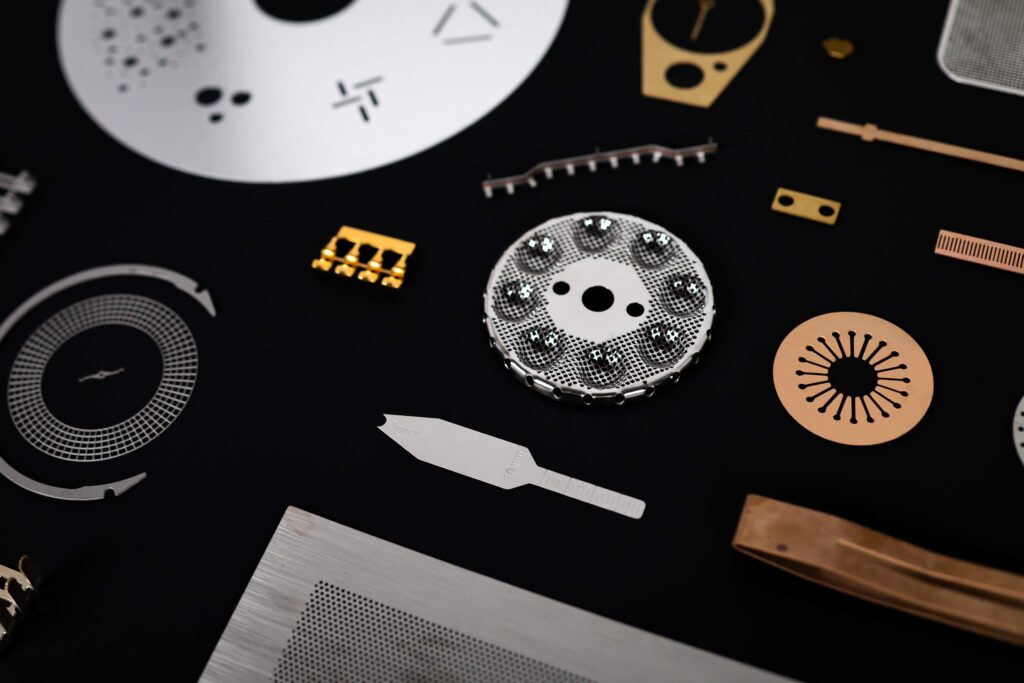
The success of a medical device often depends on the smallest details. During prototype development, even minor imperfections can affect assembly, performance, and product validation. Burrs, heat distortion, and mechanical stresses introduced during fabrication may require additional finishing operations, delay testing, or compromise the functionality of delicate components.
For engineers developing medical devices, selecting the right manufacturing method is just as important as selecting the right material. Components must meet demanding dimensional requirements while maintaining clean edges, stable mechanical properties, and consistent quality throughout the development process.
Microphoto is a leader in manufacturing precise, medical-grade metal parts for the medical industry. Our photochemical etching capabilities produce burr-free, stress-free, and strain-free parts in any temper and most types of metal. By eliminating many of the limitations associated with conventional fabrication techniques, we help engineers accelerate prototype development while maintaining the precision expected for demanding medical applications.
In this article, we explain why burr-free components are essential for modern medical devices and break down how the photochemical etching process supports rapid development of high-quality medical prototypes.
Medical products are designed with patient outcomes in mind, meaning every component must perform exactly as intended. Small defects that may be acceptable in other industries can become significant issues when manufacturing components used in healthcare.
Perhaps the most important reason for producing burr-free components is patient safety. Sharp edges or loose metal fragments can interfere with device performance, increase contamination risks, or create unnecessary hazards during clinical use.
Eliminating burrs during manufacturing reduces the need for secondary deburring processes that may introduce dimensional variation.
Modern medical assemblies often contain miniature parts with extremely tight clearances. Burr formation can prevent proper alignment during assembly, increase friction between moving components, or interfere with sealing surfaces.
When engineers are validating prototype designs, a consistent fit between components is essential for obtaining meaningful test results.
Many medical precision components perform mechanical, electrical, or fluid-control functions. Burrs may disrupt fluid flow, alter electrical contact, or reduce the accuracy of precision mechanisms.
Maintaining smooth, burr-free edges helps ensure components perform consistently throughout development and production.
Many medical parts require excellent surface quality to support cleaning, sterilization, coating, or assembly processes. Burr-free manufacturing reduces the amount of secondary finishing required while preserving critical dimensions.
Developing intricate components for the medical sector presents several manufacturing challenges, particularly when using conventional fabrication techniques.
Mechanical cutting operations frequently leave burrs along cut edges. These burrs often require secondary finishing, increasing production time and introducing additional opportunities for dimensional variation.
For prototype programs where multiple design revisions are expected, repeated deburring operations can significantly extend development timelines.
Processes such as laser cutting expose materials to localized heat.
Although effective for many applications, thermal processing may create heat-affected zones that alter material properties, reduce fatigue performance, or affect dimensional stability in thin sections.
For delicate components, preserving material integrity is often essential.
Stamping and other traditional machining methods introduce mechanical forces into the workpiece.
These stresses can produce distortion, work hardening, or slight dimensional changes that become increasingly noticeable in miniature components or thin materials.
Many traditional methods require additional processing steps, such as:
While these operations improve appearance, they also increase manufacturing costs and create additional process variation.
Conventional fabrication often depends on tooling, fixtures, or specialized equipment before production can begin.
When engineers need multiple prototype revisions, these tooling requirements can delay testing and slow product development.
Unlike mechanical cutting processes, chemical etching removes material chemically rather than physically.
The process begins by applying a photoresist image to precision metal sheets. Areas not protected by the photoresist are dissolved using controlled chemical solutions, leaving behind highly accurate component geometries.
Because no cutting tools contact the material, the process produces exceptionally clean edges without introducing mechanical stress.
The chemical dissolution process creates naturally smooth edges, producing true burr-free parts directly from manufacturing.
This eliminates or significantly reduces the need for secondary deburring operations.
Unlike thermal cutting methods, photochemical etching technology introduces no heat into the material.
Without heat-affected zones, the original grain structure and mechanical properties remain unchanged.
Since the material is chemically dissolved rather than mechanically removed, no deformation, strain, or work hardening occurs during manufacturing.
The finished component retains its original physical characteristics while maintaining outstanding dimensional stability.
Photochemical machining excels at producing intricate components with:
These capabilities make the process particularly valuable for medical prototypes where accuracy and repeatability are essential.
Medical device development often involves multiple design iterations before final validation. Unlike traditional manufacturing methods, photochemical machining supports this workflow by providing both manufacturing flexibility and exceptional precision.
Here’s how:
The clean edges delivered during the process reduce assembly issues while minimizing additional finishing operations.
Without mechanical or thermal deformation, components maintain their original material properties throughout production. The process operates at room temperature, avoiding heat-affected zones.
Because no hard tooling is required, design revisions can be implemented quickly, allowing engineers to evaluate multiple concepts in less time.
Photochemical machining enables the production of highly detailed precision metal components that would be difficult or impossible to manufacture using conventional techniques.
Fine slots, intricate patterns, and miniature openings can all be produced with excellent repeatability. In fact, photochemical etching can create features as small as 0.1 mm.
The process supports consistent dimensional accuracy across prototype builds, allowing engineers to confidently evaluate component performance during testing.
Eliminating tooling costs allows engineering teams to iterate designs without significant manufacturing investment.
This flexibility helps accelerate development while reducing overall prototype costs.
One of the major advantages of photochemical machining is that production remains consistent from prototype through higher-volume manufacturing.
Engineers can validate designs using the same manufacturing approach that supports future production, reducing risk as projects progress toward commercialization.
Modern medical technology depends on highly engineered metal components that deliver reliable performance, repeatable accuracy, and exceptional quality.
From prototype development through production, photochemical etching enables manufacturers to produce intricate parts without compromising dimensional accuracy or material properties.
Some common medical parts and components include:
Precision is essential when manufacturing surgical instruments used for cutting, grasping, and manipulating tissue. Burr-free edges improve assembly, reduce the need for secondary finishing, and help ensure instruments perform as intended.
Photochemical etching allows manufacturers to produce fine features and intricate geometries while maintaining tight dimensional control for a wide range of surgical devices.
Chemical etching produces surgical instruments with tolerances of ±0.0002 inches.
Many diagnostic devices rely on precision metal components that support imaging, sensing, and analytical functions.
Applications include:
Maintaining dimensional consistency throughout manufacturing helps improve testing accuracy and equipment reliability.
Modern sensors used for patient monitoring and detection require miniature metal components with exceptional precision.
Photochemical machining supports the production of intricate sensor elements that combine lightweight construction with excellent dimensional repeatability.
Chemical etching is used for manufacturing durable implant parts. Many implantable products contain precision metal features that require tight dimensional control throughout manufacturing.
Because photochemical etching introduces no mechanical stress, engineers can maintain consistent geometry while preserving the original characteristics of the selected material.
Controlled drug delivery systems often depend on highly accurate apertures, channels, and flow-control features.
Photochemical etching allows engineers to manufacture these precision geometries without burrs that could interfere with fluid flow or assembly.
Microfluidic technologies continue to advance across diagnostics, research, and laboratory applications.
These systems require extremely fine features where smooth edges and dimensional consistency directly influence performance.
Photochemical machining enables engineers to produce miniature flow channels and precision openings with excellent repeatability.
Portable healthcare devices continue to become smaller, lighter, and more sophisticated.
Thin photo-etched metal components support wearable technologies by providing lightweight, accurate components that integrate easily into compact assemblies.
Microphoto manufactures photo-etched medical equipment and components serving a wide range of applications within the medical sector, including:
Selecting the right material is just as important as selecting the right manufacturing process. Material properties influence corrosion performance, mechanical strength, manufacturability, and long-term durability.
Medical component photo etching can be performed using a wide variety of medical-grade materials ranging from 0.0005-inch foil to heavy-gauge metals. Depending on component geometry and thickness, tolerances typically range from ±0.001 inch to ±0.010 inch.
Common materials include:
View all the materials Microphoto etch.
Many medical environments expose components to cleaning agents, sterilization processes, moisture, and bodily fluids.
Selecting materials with appropriate corrosion resistance helps maximize product longevity while maintaining appearance and functionality.
Some medical devices require materials that meet specific biocompatibility standards depending on their intended use.
Early material selection should consider both regulatory requirements and long-term application performance.
Spring characteristics, fatigue resistance, hardness, flexibility, and dimensional stability all influence component functionality.
Matching material properties to the application’s performance requirements helps optimize reliability throughout the product lifecycle.
Not every material behaves the same during manufacturing.
Engineers should consider how material selection affects feature resolution, dimensional tolerances, forming requirements, and finishing operations before finalizing a design.
Early collaboration with manufacturing specialists can simplify this process and reduce development risk.
Developing precision medical components requires more than advanced manufacturing equipment. It requires a manufacturing partner that understands engineering challenges, material behavior, and the importance of consistency throughout every stage of development.
Microphoto has extensive experience producing precision components for demanding medical applications.
Our capabilities include:
Medical product development rarely follows a straight path.
Design refinement is a natural part of the engineering process, and prototype revisions often occur multiple times before validation.
Because photochemical etching eliminates tooling requirements, engineers can implement design changes quickly without the cost or delays associated with conventional manufacturing methods.
This allows development teams to:
Manufacturing success begins long before production starts.
Microphoto works closely with engineering teams to evaluate component designs early in development, helping identify opportunities to improve manufacturability while maintaining design intent.
Our engineering support includes:
Early collaboration helps reduce unnecessary redesign while supporting faster development.
Medical prototypes require repeatable manufacturing performance.
Microphoto applies rigorous quality standards throughout production to ensure reliable dimensional accuracy across every build.
From prototype quantities to production volumes, our processes are designed to deliver consistent results that support engineering validation and future manufacturing success.
Developing successful medical devices starts with selecting the right manufacturing partner.
Microphoto combines precision photochemical etching, rapid prototyping expertise, and engineering support to help manufacturers produce burr-free, stress-free metal components that meet demanding medical performance requirements.
Whether you’re developing a proof-of-concept prototype, refining a validation build, or preparing for production, our team can help you identify the most effective manufacturing solution for your application.
Ready to begin your next medical device project? Contact Microphoto today to request a quote for precision photo-etched components tailored to your design and performance requirements.
Need assistance selecting materials, refining component geometry, or determining the best manufacturing approach? Speak with one of our engineering specialists to discuss your application and discover how Microphoto can help accelerate your medical device development program.