Innovation in the energy sector is driven by speed. Whether developing systems, renewable energy technologies, or advanced sensing equipment, engineering teams are under constant pressure to validate concepts quickly and move projects toward commercialization faster.
Shorter development cycles have become essential for maintaining competitiveness and reducing time-to-market.
Unfortunately, prototyping delays often slow technology readiness. Traditional fabrication approaches can introduce long lead times due to tooling requirements, setup complexity, and limited flexibility during design iteration. When engineers need to adjust aperture sizes, refine flow paths, or test different geometries, waiting weeks for new tooling can stall development momentum.
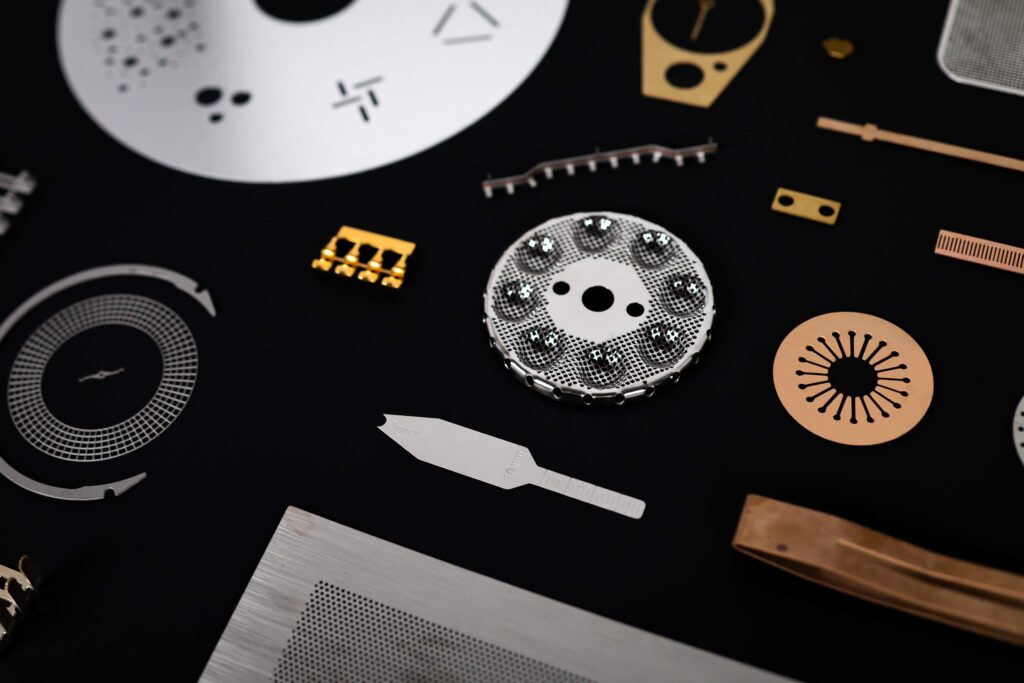
At the same time, thin metal components continue to play an increasingly important role across modern energy systems. Filters, sensing elements, flow restrictors, shielding components, precision shims, and electrical contacts all rely on highly accurate thin-gauge metal geometries to function correctly. These applications demand consistent dimensions, clean edges, and repeatable performance under challenging operating conditions.
This is where rapid iteration without tooling bottlenecks becomes essential.
In this article, we explore how photochemical machining and thin metal forming streamline energy-sector prototyping workflows, reduce dependency on traditional tooling, and support faster validation of complex metal designs.
Modern energy technologies rely heavily on engineered thin metal parts that must perform consistently in demanding operating environments. From renewable energy systems to industrial power infrastructure, thin metal geometries support a wide range of functions.
Some of the most common applications include:
Many of these applications require extremely fine features with highly repeatable geometry. Even small dimensional inconsistencies can affect flow performance, sensing accuracy, or electrical conductivity.
Thin-gauge components are valuable because they allow engineers to reduce weight, improve responsiveness, and optimize system efficiency without sacrificing structural performance. However, producing these parts accurately can be difficult when using traditional fabrication methods such as punching, stamping, or conventional machining.
Mechanical cutting operations often create burrs, distortion, and edge inconsistencies. Processes such as laser cutting may introduce unwanted thermal stress and heat-affected zones that alter material properties or reduce dimensional stability. These limitations become increasingly problematic as designs move toward smaller apertures, finer slots, and more intricate geometries.
For energy-sector prototypes where performance validation depends on accuracy, these manufacturing challenges can slow development and compromise the reliability of test results.
The photochemical machining process has become an effective solution for accelerating prototype development in energy-sector applications.
Unlike many traditional manufacturing methods, photochemical machining doesn’t require hard tooling, dies, or molds. Instead, digital artwork is transferred directly onto a coated metal sheet, allowing patterns to be chemically etched with tight tolerances. This streamlined workflow significantly reduces setup time and allows engineering teams to move from CAD design to physical prototype rapidly.
Because no hard tooling is required, design changes can be implemented quickly and cost-effectively. Engineers can modify apertures, slot dimensions, perforation layouts, or feature spacing without waiting for tooling revisions or expensive setup changes. This flexibility makes the process ideal for rapid prototyping environments where multiple design iterations are common.
The photochemical etching process also preserves the original material properties of the metal. Since the process removes material chemically rather than mechanically, no burrs, stresses, or deformations are introduced during production. The result is highly accurate, stress-free etched components with excellent edge quality and flatness retention.
Compared to other manufacturing processes, this approach is particularly valuable for thin-gauge materials, where distortion or heat damage can adversely affect part performance.
The ability to produce highly intricate geometries with extreme precision also makes photochemical machining ideal for energy-sector components requiring micro-patterns, fine apertures, or tightly controlled fluid flow paths.
While flat etched geometries are essential for many applications, energy-sector prototypes often require formed or shaped components to evaluate real-world functionality.
This is where sheet metal forming becomes a valuable complementary capability.
Thin metal forming allows prototype parts to move beyond flat profiles and into functional assemblies with bends, contours, offsets, and shaped features. By combining forming operations with photo etching, engineering teams can evaluate both geometry and assembly performance much earlier in the development process.
This integrated approach provides several advantages during early-stage R&D:
Instead of relying on multiple vendors for etching, forming, and secondary operations, Microphoto provides a unified workflow that supports faster development cycles and better consistency throughout the prototyping phase.
The ability to use the same process across multiple design iterations also helps engineers maintain dimensional consistency while refining formed geometries.
Precision filtration remains one of the primary applications for chemical etching within the energy sector.
Energy systems frequently rely on controlled filtration components to manage fluids, gases, particulates, and thermal flow. Fuel cells, hydrogen systems, cooling circuits, battery technologies, and industrial process equipment all require precision filtration elements that maintain consistent performance.
The chemical etching process enables highly accurate mesh patterns, perforation layouts, and aperture geometries that would be difficult or impractical to achieve through mechanical manufacturing methods.
Key advantages of this precision process include:
These characteristics are particularly valuable during prototype validation because they eliminate manufacturing inconsistencies that can skew test results.
Rapid design iteration is another major advantage. Engineers can quickly test multiple filter geometries, aperture sizes, or flow configurations without incurring tooling delays. This allows teams to optimize filtration performance earlier in the development cycle while reducing overall R&D risk.
For energy-sector development teams, fast access to precision custom metal parts can significantly accelerate system optimization and validation.
A key advantage of photochemical machining is speed.
By eliminating hard-tooling requirements, Microphoto helps engineering teams reduce development bottlenecks that often delay prototype validation.
Traditional tooling-based methods often require significant upfront preparation before production can begin. Tool design, machining, and setup can add weeks to a project timeline, especially when multiple revisions are required.
Photochemical machining removes these delays.
Design changes can be implemented digitally, allowing engineering teams to:
This speed advantage becomes increasingly important in competitive energy R&D environments where technology readiness milestones are tightly managed.
Because the process uses low-cost tooling, prototype programs can explore more design variations without dramatically increasing development budgets. This flexibility enables faster experimentation and allows engineers to optimize designs before committing to production tooling investments.
The etching process offers exceptional flexibility for working with thin materials and intricate geometries.
Unlike subtractive machining operations that may waste large amounts of material, photochemical machining uses efficient processing techniques to maximize material utilization. This is particularly beneficial when working with expensive alloys or specialized energy-sector materials.
The process also supports highly complex features, including:
Because designs are digitally driven, engineers can refine geometry without retooling or restarting the entire manufacturing workflow.
This flexibility allows teams to optimize component performance before scaling into production.
It also enables greater design freedom than many conventional fabrication techniques. Thin-gauge metals that may be difficult to process through stamping or machining can often be etched with superior dimensional control and cleaner feature definition.
For many energy applications, maintaining precise geometry across varying material thicknesses is essential for reliable performance.
One of the strengths of photochemical machining is its ability to support both prototyping and production manufacturing.
The same core process used for early-stage prototypes can be scaled for production runs, helping reduce redesign risks between development and commercialization.
This continuity provides several benefits:
Because prototypes are manufactured using production-capable workflows, engineers gain clearer insight into how parts will behave during scaled manufacturing.
This is especially important for energy hardware programs where validation timelines are closely tied to funding, certification, and deployment milestones.
By aligning manufacturing strategy early, engineering teams can move toward commercialization with greater confidence.
At Microphoto, our expert team specializes in precision photochemical machining for thin-gauge, intricate metal components where flatness, tight tolerances, and burr-free edges are essential to performance. We combine advanced thin metal forming with precision photochemical machining to help energy-sector engineering teams speed up prototype development without sacrificing dimensional accuracy or material integrity.
Our integrated approach helps you iterate faster, design more flexibly, and validate prototypes reliably for demanding applications. From filtration systems and sensor components to flow control elements and precision assemblies, we consistently deliver the consistency and responsiveness required to support high-performance energy technologies from concept through production.
Energy innovation depends on rapid iteration, accurate validation, and scalable manufacturing strategies.
By combining thin metal forming with precision photochemical machining, Microphoto helps reduce the development friction that often slows early-stage energy programs. The ability to quickly produce highly accurate, burr-free thin metal components enables engineering teams to validate designs more quickly while maintaining the material integrity required for demanding applications.
Compared to conventional machining or tooling-based production methods, photochemical machining offers substantial advantages in flexibility, turnaround speed, and design freedom. Engineers can test more ideas, refine geometries rapidly, and optimize system performance before committing to production-scale manufacturing.
As energy technologies continue evolving, precision manufacturing will play an increasingly important role in accelerating innovation.
If you’re looking for a partner for high-performance precision metal parts, Microphoto can help. Our machining process delivers parts that meet exact specifications while supporting faster development cycles.
Whether your application involves filtration systems, sensing technologies, flow control components, or advanced energy hardware, our team can help streamline your path from concept to validated prototype.
Contact Us today or Request a Quote.